This project began with a dilemma. One that many probably face on a daily basis: how to discard something you are attached to, something that is objectively useless yet difficult to let go of. For many, it is easy enough to see a piece of trash that they no longer need and just toss it. For me and many like myself, each piece of trash holds a memory, each item has history, making it tougher to part with. I created this project to allow myself to record the memory and history associated with these items, so even when the physical item is thrown away, its memory is still with me.
Each week, I gather 9 items that I am discarding and talk about their memories, research its history, and gather some data on each item to add to a table. Having a consistent format to work with ensures that I am able to record enough information for every item, and to make sure I’m not paying more attention to one item and neglecting another during my research. It also helps keep everything organized and uniform as the weeks go on. Each item is easy to find and easy to learn about with the in-text links.
I had quite a few inspirations for taking on this project. This project is somewhat similar to the "7 Days of Garage” project by Gregg Segal, which I learned about in UChicago News' “An Archaeologist Talks Trash", an interview with anthropologist Sarah Newman. She uses it to illustrate how trash reveals qualities about ourselves that we might not consider. Newman is an author and an assistant professor at the University of Chicago’s anthropology department. A lot of her work focuses on the history of waste, recycling, and environmental issues. In the article, she mentions that many ancient civilizations viewed trash differently, and that this varied across different time periods. In early 16th century Tenochtitlán, waste was viewed as something that could be repurposed and reused. Accordingly, I was inspired to reframe things that are being thrown away as things that have a part in a story, things that were used.
I also take inspiration from contemporary art, specifically artist Vik Muniz and the “Museum of Ashes” series along with his “Pictures of Garbage” series. In his New York Times article, “Reframing Trash Into Art”, he illustrates how trash in the landfills of Jardim Gramacho and the ashes of priceless museum artifacts have more in common than expected. Both hold items of value that are now forgotten. However, Muniz, through his writing and art, shows that these items are alienated only if we choose. His art reimagines the garbage of Gramacho as the lives of those who have lived and worked there. He recreates images of artifacts lost in the museum fire from the actual ashes of those items. The term “trash” carries a negative connotation; however, Muniz makes it clear that trash is simply objects whose stories have come to an end, useful or valuable items that remain as such only in memories. Items that have now been abandoned, yet their value remains in the story they tell. I aim to tell the story of my trash, explore their history, and appreciate their value even as I am about to get rid of them.
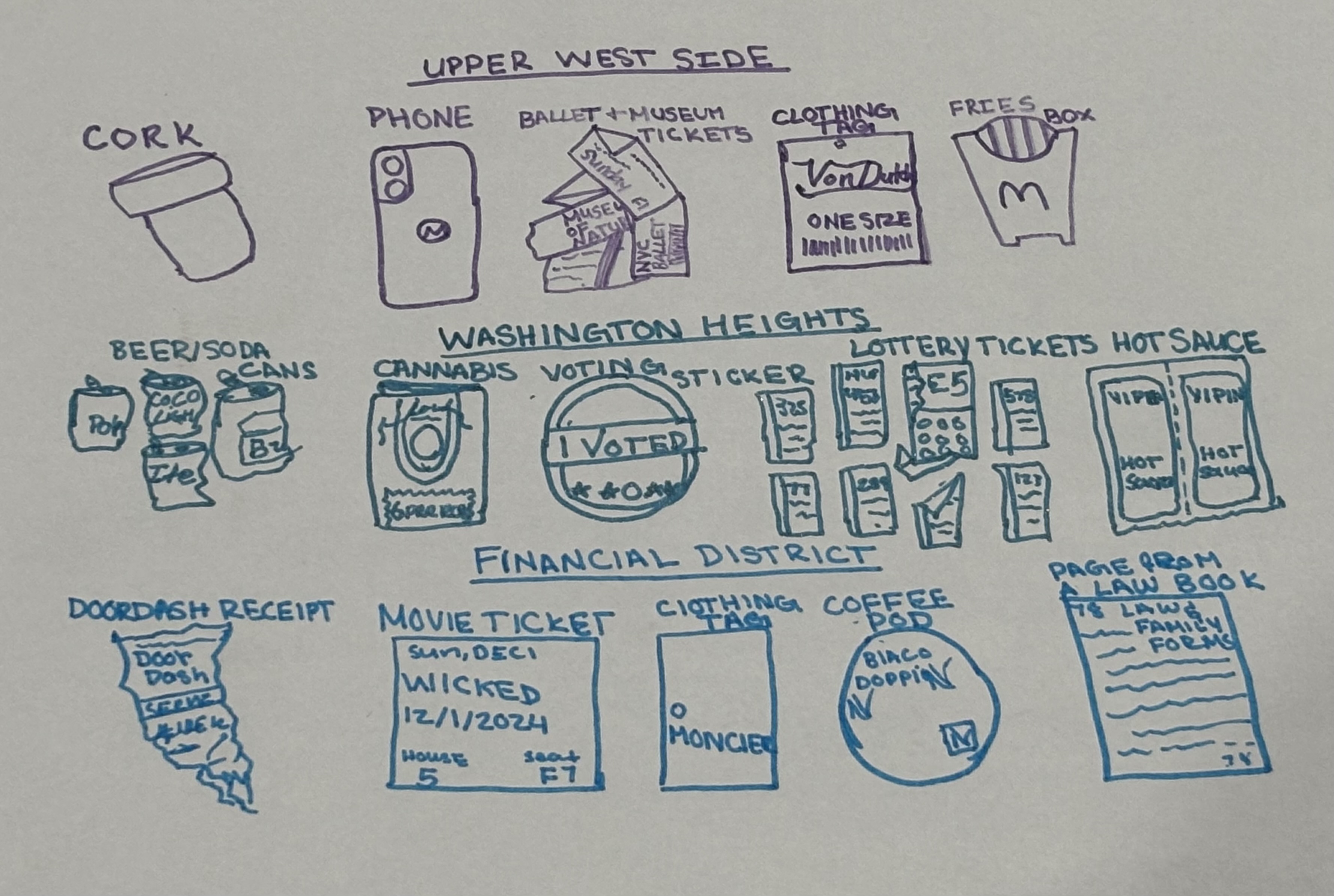
Finally, the article that really drove me to take the initiative to start this website, one I implore everyone to check out, “What Can Hundreds of Pieces of Litter Tell Us About Manhattan?”. Here artist and photographer Emilie Gia Mẫn Rolland and reporter John Leland combine their talents to put together a gallery of litter found around the districts Manhattan and an analysis on what it tells us about the social and cultural scene of that district. This inspired the gallery of trash that I create each week, because it says a lot about the social and cultural scene of my life.
I’m Niva Shah, a student at Rutgers University New Brunswick. I enjoy exploring the outdoors, hiking, and rock climbing. My love for the environment has made me more conscious about disposing of habits, and I hope that as I track my trash, I can improve how I discard items—focusing on recycling and donating, over throwing out. I love learning new things, whether that be gaining knowledge or learning new skills. Through this project, I hope to learn more about the everyday items I may take for granted.
I like watching movies, binge watching TV shows, listening to music, having silly debates on unserious topics, and building legos. These are just a few things about me, but you will get to know me a lot better by looking through my trash. Check it out here!